
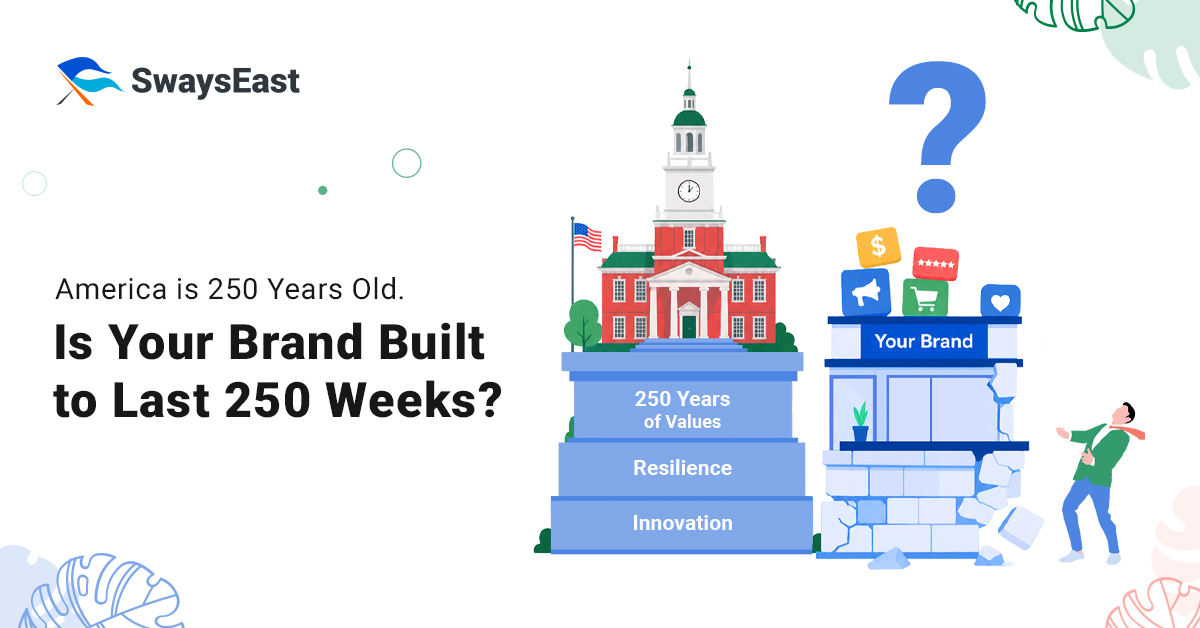
On July 4, 2026, the United States celebrates its Semiquincentennial. Surviving 250 years requires massive coordination and the constant management of deeply divided, shifting internal forces.
While the nation honors a quarter-millennium of endurance, engineering a brand built to last 250 weeks (about 4.8 years) is a fragile hurdle that most modern businesses fail to clear.
According to official data from the U.S. Bureau of Labor Statistics, 20.4% of new businesses close in year one. By year five—the 250-week mark—49.8% collapse. Even corporate giants aren’t safe; the average lifespan of an S&P 500 company has shrunk from 33 years in 1965 to just 14 years in 2026.
To clear this five-year cliff, brands can apply three strategic playbooks drawn from America’s own historical survival themes.
1. Adapt to the AI Search Revolution
Historical Theme: Unfinished Revolutions
The digital landscape is undergoing a permanent shift. Users are bypassing standard search listings for direct answers from platforms like Google, ChatGPT, and Perplexity. Today, zero-click searches account for 58.5% of all queries.
Because AI Overviews answer basic questions directly on the results page, generic summaries no longer bring traffic. To survive, you must offer Information Gain:
The Information Gain Rule: Generative AI engines build answers by scanning the web for unique data, original research, and primary insights. If your site just repeats what is already out there, AI models ignore it, rendering your brand invisible.
Enduring brands must publish original research and primary statistics to become the core sources cited by AI engines, capturing high-intent traffic.
2. Diversify Your Regional & Platform Footprint
Historical Theme: Power of Place
Where you build matters. Data shows that local economic ecosystems heavily impact survival rates in a business’s first year:
| State / Region | 1st-Year Failure Rate | Key Structural Pressures & Relievers |
| Washington | 40.8% | Intense tech clustering, rapid wage inflation, early cost pressures |
| District of Columbia | 32.2% | High administrative overhead, strict local regulatory demands |
| Massachusetts | 19.2% | Strong economic stability from dominant academic/healthcare anchors |
| California | 18.5% | Deep access to venture capital networks and local support ecosystems |
But “place” also applies to the digital platforms you call home. Relying on a single third-party channel—like an algorithm-dependent social media platform or search engine—is an existential risk. Long-term resilience means moving your audience away from rented channels and into owned ones, like an opt-in email database.
3. Align Directly with Human Psychology
Historical Theme: We the People
Enduring brands map their entire content workflow to the user’s specific mental state. Roughly 60% of all online queries are informational. If you try to sell to someone who is just trying to learn, they will bounce immediately.
| User Intent | Psychological Goal | Optimal Format | Expected ROI |
| Informational | Learn or resolve a complex question | Long-form articles, original data | Earns citations from AI engines |
| Commercial | Compare options and reduce risk | Comparison guides, alternatives | Captures active, mid-funnel prospects |
| Transactional | Execute a purchase or subscribe | Direct product pages, clear forms | Lowers acquisition costs, drives revenue |
The Growth Ecosystem: Designing for Agility
To run these strategies efficiently without breaking your operational budget, modern teams use integrated marketing ecosystems like SwaysEast to eliminate data silos:
- Cabana: Manages content production with strict parameters for word count, readability, and keyword density. ($80/mo Starter, $247/mo Pro)
- Riptide: Tracks email interactions, analyzing open locations and device compatibility. (Limits from 500 to 50,000 emails/mo)
- Waves: Automates email marketing campaigns and list segmenting based on user behavior. (Up to 10,000 contacts)
- TikiBar: Automates scheduling with automated timezone translation and team round-robin distribution.
Lessons from Multi-Centennial Icons
We can look to historic American brands that have successfully scaled across centuries by modernizing their core delivery:
- Caswell-Massey (1752): America’s oldest fragrance brand survived by pivoting its historic prestige from old-school brick-and-mortar stores into a modern, e-commerce-first digital brand.
- The Hartford Courant (1764): The country’s oldest continuously published newspaper overcame severe Revolutionary War paper shortages by building its own paper mill. Today, it survives digital disruption by pivoting from print ads to digital subscriptions.
- King Arthur Baking Company (1790): Originally a traditional flour importer, they completely transformed their business model by becoming 100% employee-owned (ESOP) and launching online baking schools, boosting digital sales by 200% when home baking demand shifted.
The 3-Step Survival Checklist
To scale past the 250-week cliff, your immediate priorities are:
- Consolidate Your Tech: Ditch disconnected applications that isolate your data. Use unified platforms like SwaysEast to track content performance and customer behavior under one roof.
- Own Your Audience: Prioritize your direct subscriber lists over social media followers. Algorithms change; your email database belongs to you.
- Enforce Content Standards: Stop publishing generic copy. Use content creation tools like Cabana to ensure every asset contains original data, matches user intent, and is built to be cited by modern AI search models.
Ready to build your influence? SwaysEast offers a suite of smart digital marketing tools to help brands create innovative solutions and experience their very own AI digital marketing success stories. Book a FREE APPOINTMENT today.