
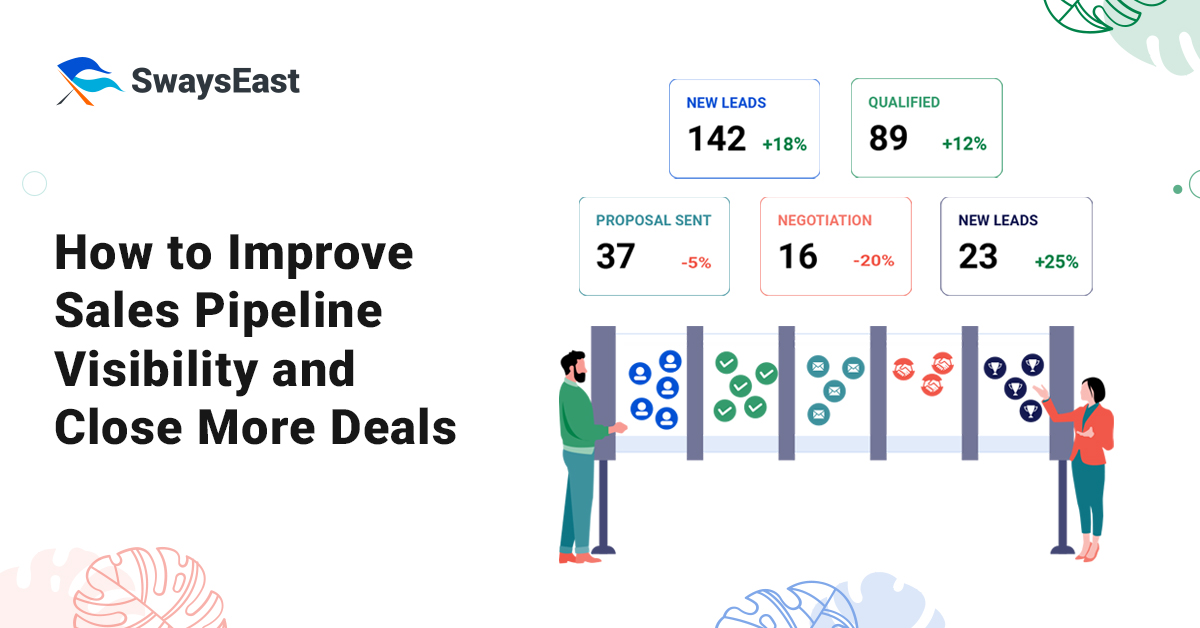
There’s a strange irony in the modern sales office: we have more dashboards than ever, yet most sales leaders still feel like they’re flying through a fog bank. You’ve got the data, the CRM is green, and the pipeline looks healthy on paper. Then the end of the quarter hits, and half those “sure things” vanish into the ether. The reality is that we are currently facing a massive gap in sales pipeline visibility, where subjective manual updates are masking the true health of our deals. If you want to close more deals in 2026, you don’t need more leads; you need to see the ones you already have with high-definition clarity.
If you want to close more deals in 2026, you don’t need more leads. You need to see the ones you already have with high-definition clarity.
The Visibility Gap: Why Your CRM is Lying to You
Most organizations confuse pipeline management with pipeline visibility.
- Management is administrative. It’s a rep moving a deal from Discovery to Proposal because they had a nice chat. It’s subjective, manual, and often optimistic.
- Visibility is objective. It’s knowing that while the rep thinks the deal is moving, the prospect hasn’t opened the last three emails or shared the proposal with their CFO.
To bridge this gap, you have to stop looking at declared status and start looking at execution signals. According to recent Salesforce State of Sales reports, only 28% of reps hit their quotas last year, largely due to this disconnect between data and reality.
| Feature | Sales Pipeline Management | Sales Pipeline Visibility |
| Primary Input | Subjective rep updates | Objective engagement signals |
| Core Focus | Moving deals through stages | Identifying risk and priorities |
| Data Source | Manual CRM entries | Integrated email, calendar, & content |
| Outcome | Historical reporting | Real-time coaching |
| Risk Mitigation | Reactive (post-mortem) | Proactive (early intervention) |
Building the Glass Pipeline with SwaysEast
To get this level of clarity, your tech stack needs to act like a nervous system, not a filing cabinet. This is where tools like SwaysEast change the game. By integrating your outreach and content into a single ecosystem, you illuminate the dark stages of the buyer journey.
1. Waves: No More Ghosting
The dark stage is that awkward silence between a demo and a closed contract. The Waves module uses AI-driven analytics to track how prospects interact with your sequences. If a prospect clicks on a specific link in your email but doesn’t reply, that’s a signal. Waves’ automated sequencing ensures you stay top-of-minded without being a nuisance, preventing the 37% of funnel drop-out caused by simple lack of engagement.
2. Cabana: Peeking Inside the Black Box
Content is usually a black box. You send a deck, and you hope they read it. Cabana turns that deck into a data source. You can see who is reading which slide and for how long. Its Analyze as you type feature even helps you tweak the tone of your proposals in real-time to match the buyer’s sentiment, reducing the cognitive load on the customer and making yes an easier answer.
The Math of Momentum: Sales Velocity
Visibility isn’t just a feeling—it’s a science. High-performing teams in 2026 aren’t just looking at the number of leads; they are obsessed with Sales Velocity.
If you use Waves to automate follow-ups and shave five days off your average sales cycle, your velocity increases exponentially even if you don’t find a single new lead. Visibility allows you to see which lever to pull.
Key Metrics to Watch (The Health Check)
- Pipeline Health Ratio: The value of deals actually moving vs. zombie deals that haven’t had activity in 60 days.
- Deal Slippage Rate: How many deals get pushed to next month? If this is over 20%, your visibility into the buyer’s internal procurement process is broken.
- Account Engagement Score (AES): Is your rep only talking to one person? Single-threaded deals are where revenue goes to die.
Strategy: Navigating the Age of Indecision
In 2026, you aren’t just competing against other vendors; you’re competing against indecision. Research shows nearly half of lost deals are simply no decision results. Buyers are anxious about making the wrong move.
Mastering the Art of the Close
To combat this, your human sellers need to move from being information providers to decision facilitators.
- The JOLT Framework: Judge the indecision, Offer a recommendation, Limit the options, and Take control.
- The Summary Close: Don’t just ask for the order. Synthesize the entire journey. “We’ve seen that SwaysEast can cut your manual entry by 40% and integrate your silos. Does Monday work to start onboarding?”
| Closing Technique | Ideal Use Case | Strategic Example |
| Assumptive Close | High-trust relationships | Shall we schedule the onboarding for Tuesday? |
| Summary Close | Complex, multi-stakeholder deals | As we’ve discussed, this solves [X] and [Y]… |
| Alternative Close | Analytical buyers | Would you prefer the Standard or Enterprise tier? |
The Pipeline of the Future
As we move toward 2027, the goal is for the pipeline to clean itself. We’re seeing a shift toward RevOps as the ultimate gatekeeper of data integrity.
By using the SwaysEast suite, you’re not just buying tools; you’re building a system where marketing and sales finally speak the same language. Marketing sees the downstream impact of their content via Cabana, and Sales gets warm leads identified by Waves.
The Bottom Line
Visibility isn’t about micro-managing your reps. It’s about empowering them. When you can see the risks before they become losses, you stop reacting to your pipeline and start orchestrating it.
Ready to stop flying blind? Audit your pipeline stages this week. If a deal doesn’t have an execution signal (an email open, a content view, or a multi-threaded meeting) in the last 14 days, it’s not a deal, it’s a ghost. It’s time to turn the lights on.
SwaysEast offers a suite of smart digital marketing tools to help brands create innovative solutions and experience their very own AI digital marketing success stories. Book a FREE APPOINTMENT today.